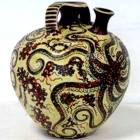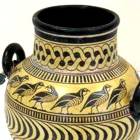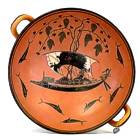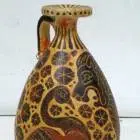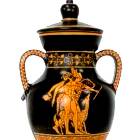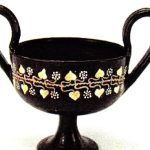

In the late 8th century, when the Geometric style was coming to an end, Corinthian contact with the Near East was a stimulus for the Orientalizing style of Greek pottery.

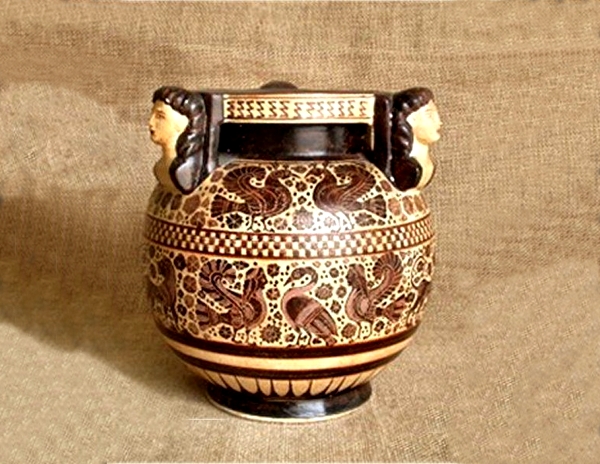
The traditionally angular geometric patterns were being replaced with the curvaceous flora and fauna that typify the Protocorinthian style.
For much of the 7th and 6th centuries Corinth led the Greek world in producing and exporting pottery.
The stylized geometric lines gave way to animal and human figures with rounded contours and considerable animation.
Figures such as those that might have been found on Eastern rugs and textiles were dominant in a rhythmic design of floral patterns, dots and rosettes filling the entire background.


The Corinthian pottery style was also characterized by an expanded vocabulary of motifs: sphinx, griffin, lions, etc., as well as a repertory of non-mythological animals arranged in friezes across the belly of the vase. In these friezes, painters also began to apply lotuses or palmettes.
Depictions of humans were relatively rare. Those that have been found are figures in silhouette with some incised detail, perhaps the origin of the incised silhouette figures of the black figured pottery period.
Check out greek culture inspired products on our online greek art shop!
No account yet?
Create an Account