Hagion Oros – also known as Mount Athos – is located in the eastern of the three fingers of Halkidiki, surrounded by the Aegean Sea. The peninsula has been inhabited since antiquity. This is what Herodotus says, but the traces of ancient dwellings also bear witness to it. Although involved many times in political and military events of the antiquity up to the imperial period, Mount Athos would not really play an important role until the time of the Byzantine Empire. During Late Antiquity the peninsula remained practically uninhabited. Over the centuries, Hagion Oros evolved into a self-governing monastic republic, with its monasteries, sketes, and hermitages forming a unique spiritual landscape.
The historical turbulent transitions of the Middle Ages – the advance of Islam, monks who left the eastern regions of the empire under the pressure of the Arab conquests, persecutions of iconoclasts launched by the emperors of Constantinople – made it a place of refuge for hermits and probably for all the small monasteries communities, whose members lived in small cells united around a modest prayer space from the 7th-8th century or even earlier. Even if it is no longer possible to gather reliable historical information about the above, the Athonian tradition always wanted to go back very far in time in the first forms of monastic life on the mountain – hermitic or communal – and possibly supported its credentials in the production of historical documents which proved its pious past.
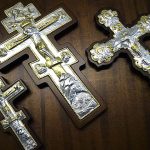
Whatever the value of the legends, which in any case is undetermined, the fact is that the place due to its extremely attractive natural configuration – wooded hills that rise to the top of Hagion Oros (2,033 m.), between sky and sea, immersed in silence and solitude – must have attracted from a very early age Christians who wished to live a hermit life. Within this sacred landscape, the timeless symbolism of greek orthodox crosses adorns chapels and monastic dwellings, embodying the enduring faith and devotion of its inhabitants.
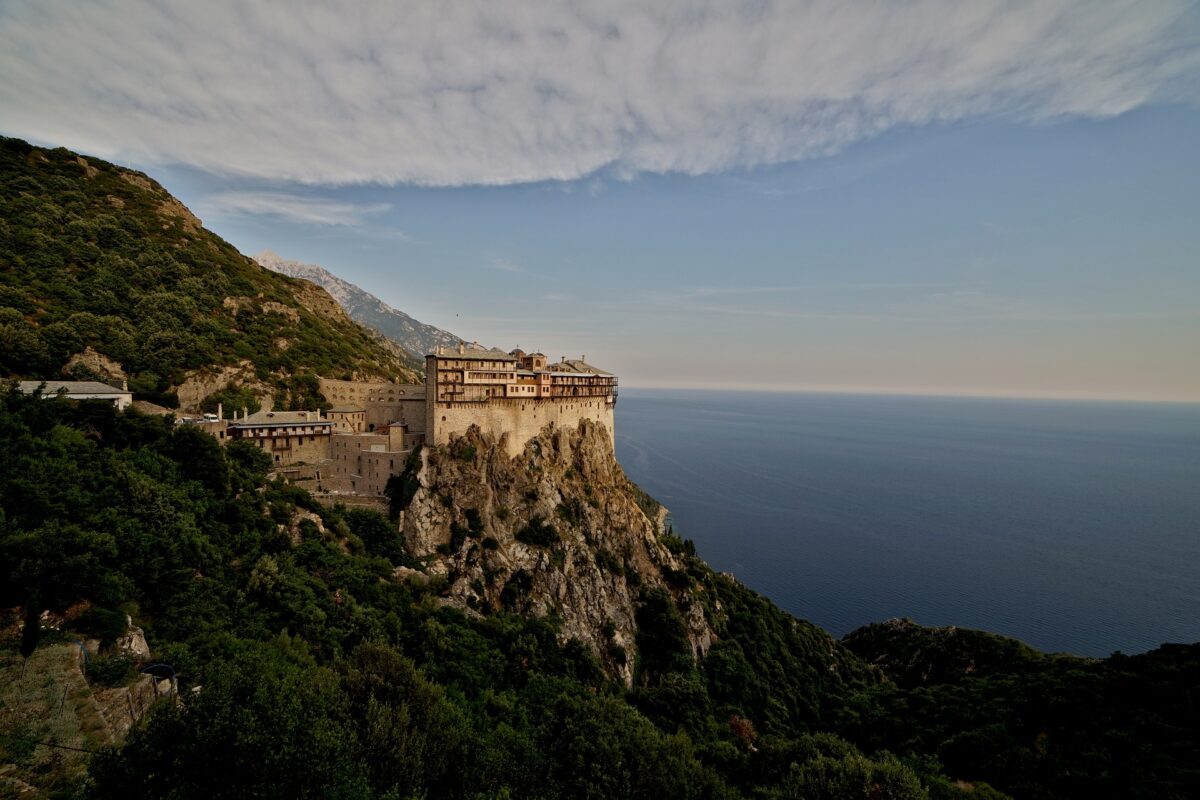
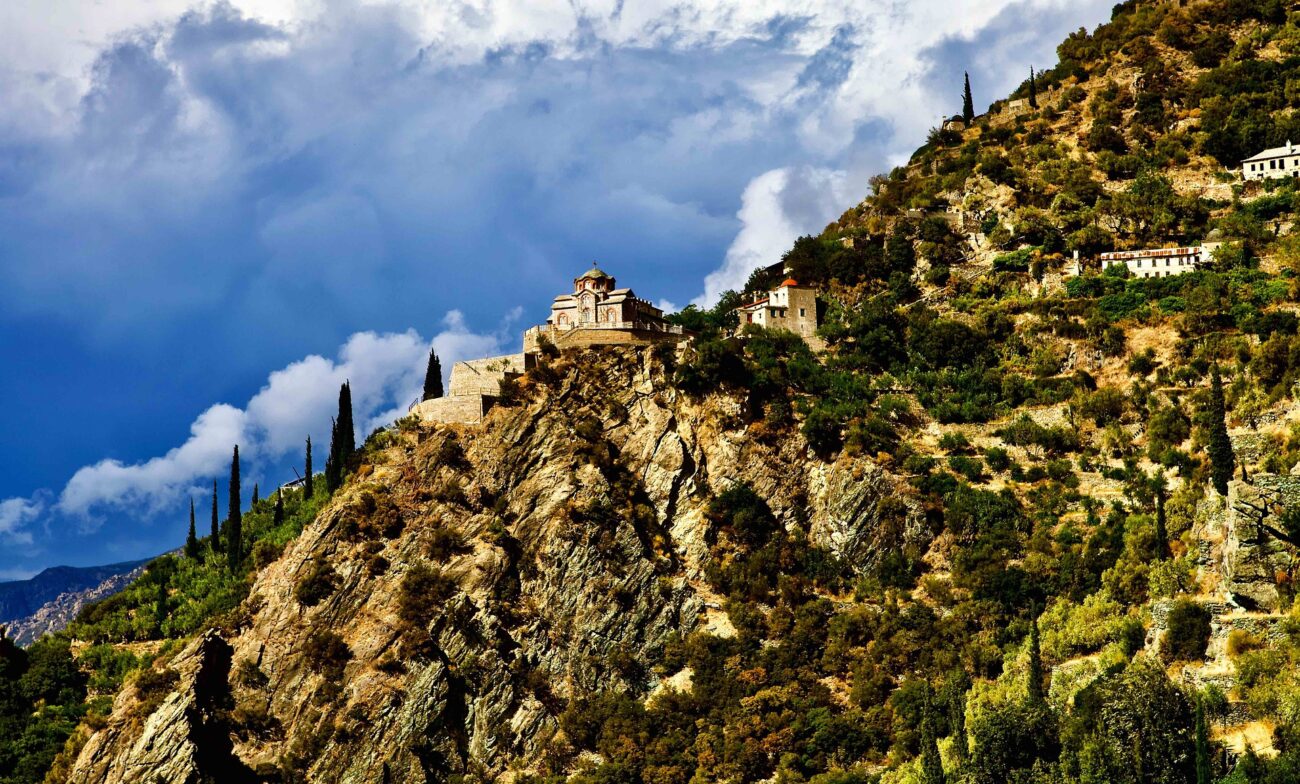
During its history, Athonian monasticism recorded the appearance, change of legal status and disappearance of smaller monasteries. Numerous figures in history, more or less important, intervened with measures and regulations to determine customs, economy, management and administration, until the present day. This goes back to the Greek Constitution of 1924, passed in 1926, ratified by the Greek Constitution of 1952 and finally accepted by the European Community in 1981. Divided among the 20 major monasteries and their dependents, which also follow a hierarchical order defined since long ago, the territory of the peninsula has been an integral part of the Greek state, even if it enjoys a special status. All its inhabitants, from the moment they become monks, receive Greek citizenship from this fact alone. From a spiritual point of view, Hagion Oros is directly under the Ecumenical Patriarchate of Constantinople. But the real power is exercised by the Holy See. This central government of Hagion Oros, which changes every year according to a rotation system, includes representatives from all the monasteries.
But it is clear that the deepest history of Hagion Oros, this most unique place in the world, belongs to another dimension which, although this may seem paradoxical, escapes in some way from all sense of history: it is the dimension of spiritual experience, of encounter with God in the perfect imitation of the Gospels, this God that each of the Athonite monks, from the Saints to the most insignificant and ignored hermits, came to seek.
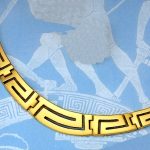
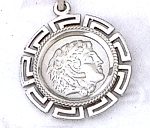
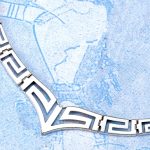
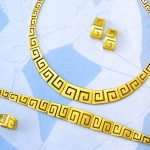
Find out more about the Mt. Athos Collection at the Greek Art Shop of Hellenic Art!
No account yet?
Create an Account