The iconostasis is a unique architectural structure that separates the temple from the pulpit. The term iconostasis literally means “support of icons” since it supports numerous icons. In the first years, the sanctuary where the Divine Liturgy was held was not separated from the temple except by a small marble partition which did not prevent the faithful from seeing the altar. During the Byzantine Middle Ages, perhaps due to the reaction caused by the iconoclasm, the small partition was replaced by a colonnade on which was the architrave with images, which, however, allowed the faithful to see the priest. Over the years, the decoration gained more and more height thus creating a real partition which, perhaps from the second half of the 14th century, took its definitive form adopted by all Orthodox churches.
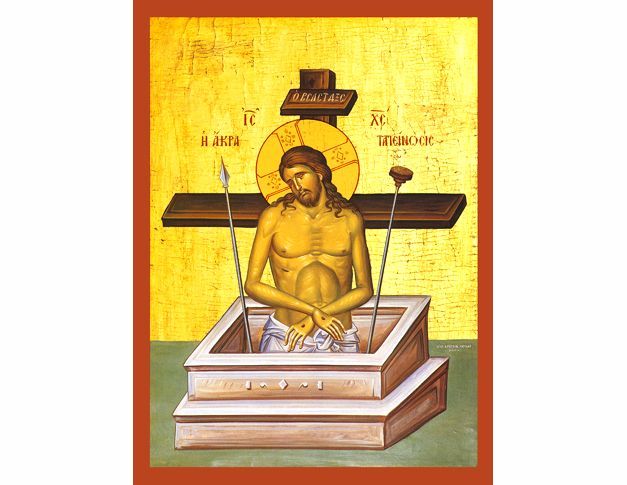
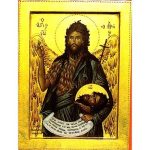
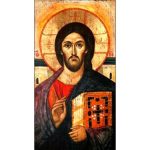
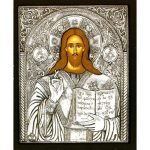
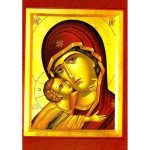
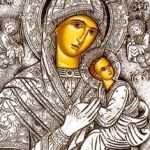
Generally the iconostasis is of carved, gilded wood. Decorative designs from the plant and animal kingdoms serve as a framework and support for the numerous icons that decorate it. The arrangement of the icons, far from random, has a strict form imposed by the tradition of the Orthodox Church. The central door of the iconostasis is called the Royal Gate or the Beautiful Gate. To its right are the icon of Christ the Almighty and the icon of John the Baptist the Forerunner. To the left are the hand painted icons of Virgin Mary and the patron Saint of the church. These four images are called despotic.
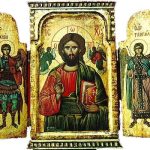
The icon of the Annunciation, the angel on the left and the Virgin on the right are placed on the pilasters of the central door. The two side doors have the images of the archangels Michael and Gabriel. When space permits, the icons of Michael and Gabriel occupy the space of the iconostasis to the left and right of the two side doors. Above the Beautiful Gate is the image of the Last Supper or the Holy Mandlion, in which there is the acheiropoiito (not made by human hands) image of the face of Christ.
Along the arch of the iconostasis, which forms a kind of border, we may find the composite image of Deisis and the cycle of the Twelve Great Feasts (Dodekaeorton). The Great Commission is formed by a series of icons representing Christ in the center, the Virgin Mary on His left with the Baptist on His right, the Archangels, the Apostles and the Evangelists, all arranged in a predetermined hierarchical order. Christ is presented as the Pantokrator. The other figures lean towards Him in an attitude of prayer and supplication. John the Baptist represents the intercession of the Old Testament church and the Virgin Mary represents the intercession of the New Testament church.
The portico is often decorated with the order of the Twelve Great Feasts of the Byzantine liturgical year. In this case, when space allows, the Trimorph is also introduced in some cases, which is a Deisis and consists of three main images: Christ, the Virgin Mary and John the Baptist. At the top of the iconostasis Christ Crucified is placed and on each side, in a sad and melancholy posture, Mary and the Apostle John.
The two side doors are considered entrances to the pulpit and are mainly used by the deacons. Only bishops and priests are allowed to pass through the central gate, which is reached by a corridor carved into the floor or more commonly by a raised semicircular step, the solea.
Discover more about Greek Orthodox Icons from the website of the Greek Art Shop of Hellenic Art.

No account yet?
Create an Account