
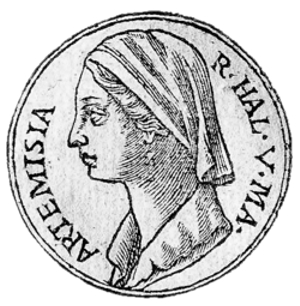
Artemisia I of Caria was a queen of the satrapy (province) of Caria (near modern day Bodrum in Turkey), mostly known for taking the side of the Persian king Xerxes during the Greco-Persian wars.
Her father was the satrap of Halicarnassus, Lygdamis I and her mother was from the island of Crete. She took the throne after the death of her husband.
She was an ally of Xerxes I during the Second Persian invasion of Greece. She fought at the naval Battle of Artemisium and the naval Battle of Salamis in 480 BC as a commander in the Persian navy. She was the only female commander according to Herodotus.
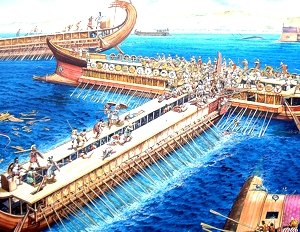
Before the battle of Salamis, Xerxes gathered all his naval commanders and sent Mardonios to ask whether or not he should fight a naval battle the commanders advised him to fight a naval battle except Artemisia.
Xerxes was pleased with her advice and while he already held her in great esteem he now praised her further. Despite this, he gave orders to follow the advice of the rest of his commanders.
Xerxes thought that at the naval battle of Artemisium his men acted like cowards because he was not there to watch them. But this time he would watch the battle himself to ensure they would act bravely
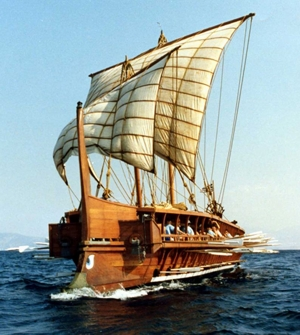
Artemisia led the forces of Halicarnassos, Cos, Nisyros and Calyndos , and supplied five greek ships. The ships she brought had the best reputation in the whole fleet.
As Herodotus says, during the battle and while the Persian fleet was facing defeat an Athenian ship pursued Artemisia’s ship and she was not able to escape because in front of her were friendly ships. She decided to charge against a friendly ship manned by people of Calyndos. The Calyndian ship sank.
When the captain of the Athenian ship, saw her charge against a Persian ship, he turned his greek war ships away and went after others, supposing that the ship of Artemisia was either a Greek ship or was deserting from the Persians and fighting for the Greeks.
While Xerxes was overseeing the battle from his throne, which was at the foot of Mount Egaleo, he observed the incident and he and the others who were present thought that Artemisia had attacked and sunk a Greek ship. None of the crew of the Calyndian ship survived to be able to accuse her otherwise.
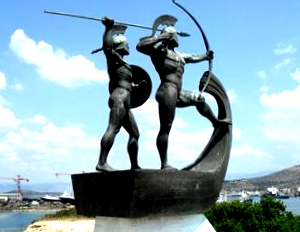
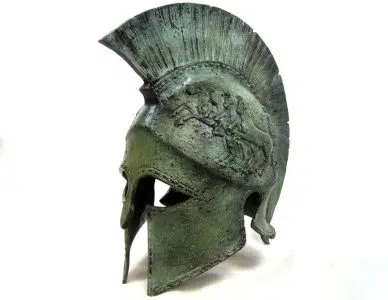
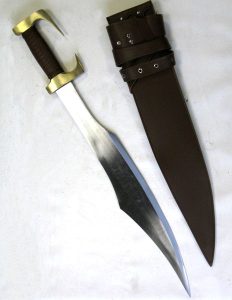
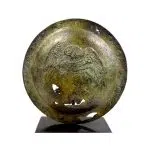
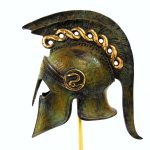
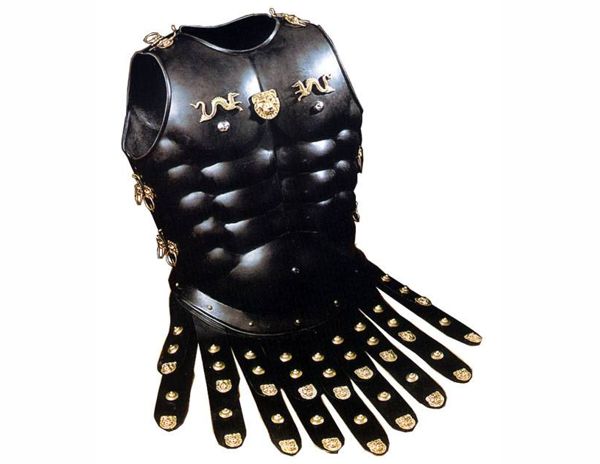
After the battle Xerxes acknowledged her to have excelled above all the officers in the fleet and sent her a complete suit of Greek armour and he presented the captain of her ship with a distaff and spindle.
Xerxes then sent her to Ephesus to take care of his illegitimate sons. In return, Artemisia’s lands did well by their alliance with the Persians.
A legend claims that later Artemisia fell in love with a man named Dardanus, and when he ignored her, an oracle told her to jump to her death into the Aegean Sea from the rock of Leucas.
If you want to find out more about Artemisia of Caria, explore the greek art shop website of Hellenic Art!
Source: Wikipedia
No account yet?
Create an Account